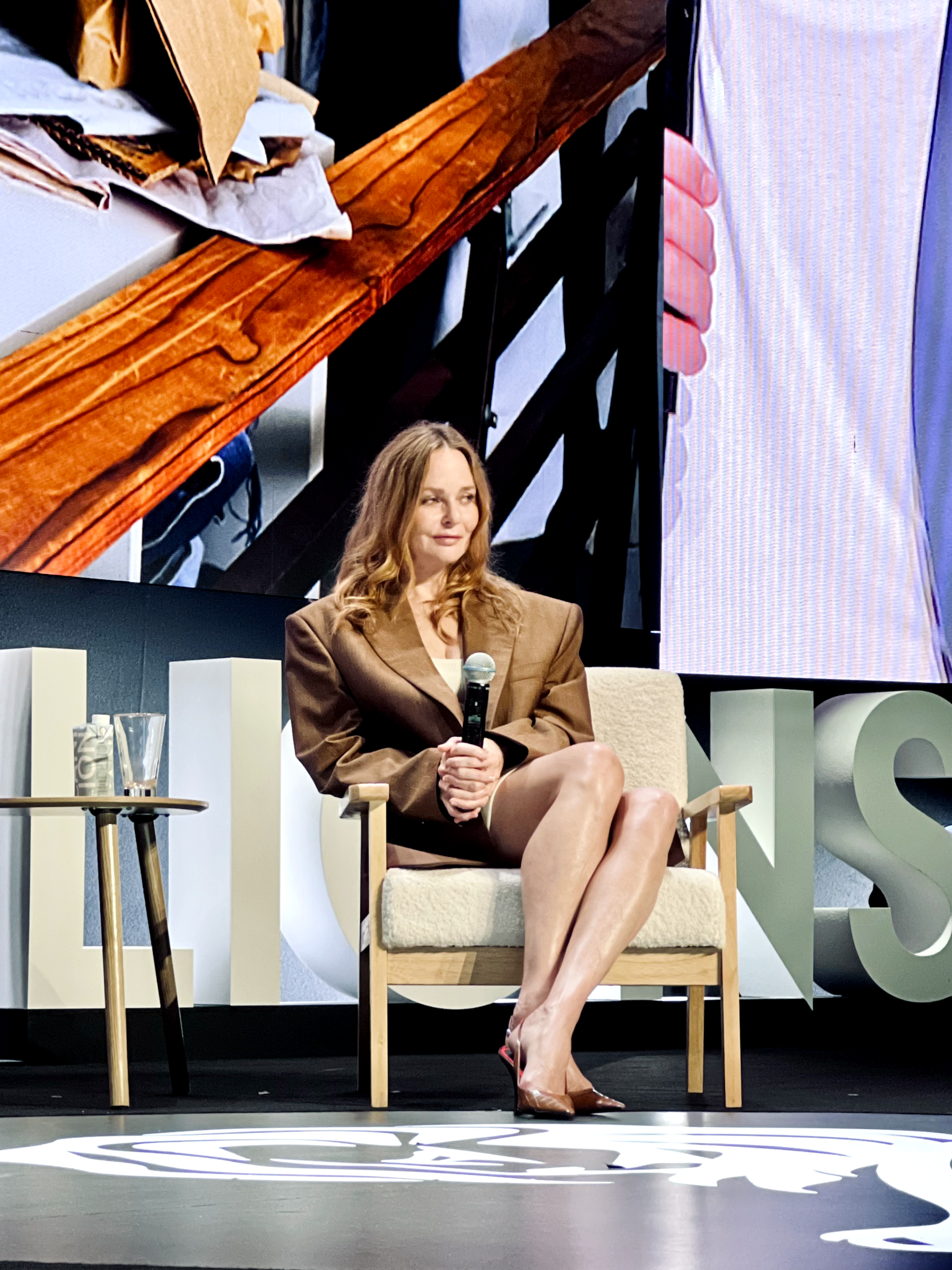
Stella McCartney at Cannes Lions 2026 on How Circular Commerce Is Changing Fashion
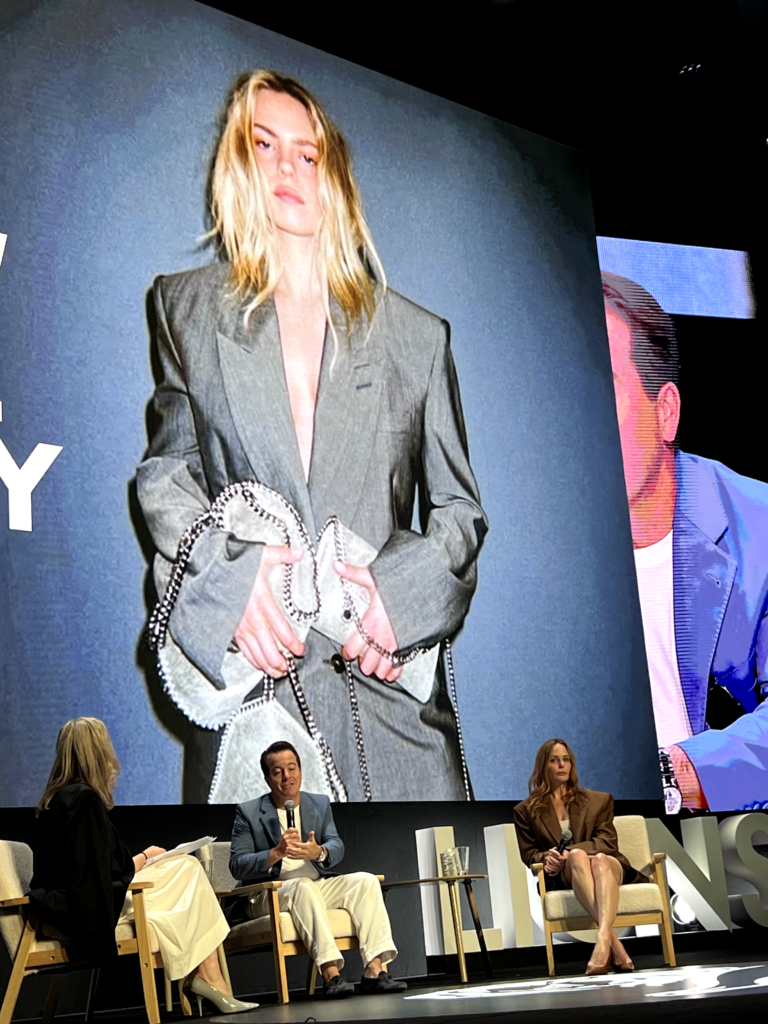
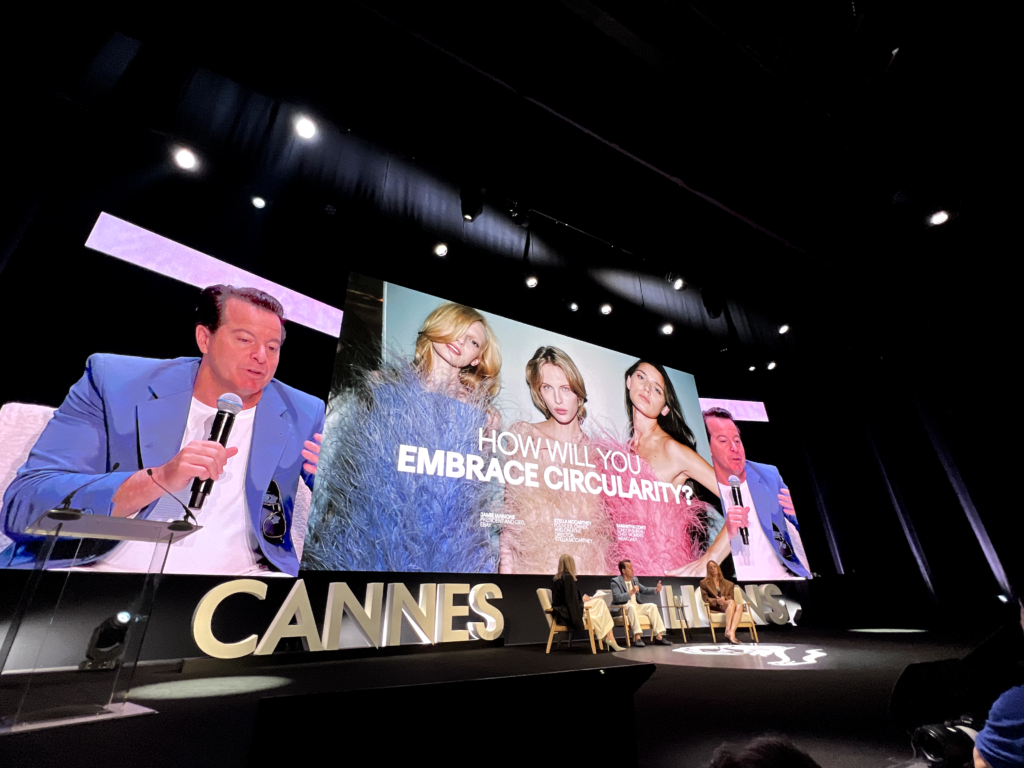
At the international festival of creativity Cannes Lions 2026, a panel discussion titled “Everyone is a Seller: Circular Commerce is Redefining Creative Industries” took place.
The creative dialogue featured:
- Stella McCartney — Founder, Owner, and Creative Director of the Stella McCartney fashion house, and a pioneer of sustainable fashion;
- Jamie Iannone — Chief Executive Officer of the global trading platform eBay;
- Samantha Conti — London Bureau Chief of the authoritative publication Women’s Wear Daily (WWD), who served as the moderator of the discussion.
The experts discussed tectonic shifts in consumer behavior: the line between buyer and seller is fading completely, while resale and circular models are becoming key drivers of the creative economy.
We are publishing the highlights of this dialogue to inspire your creative practices in circular economy, conscious consumption, and environmental care.
Samantha Conti: Secondhand, resale, repair and reuse are becoming much more than sustainability practices — they are redefining creativity and business models. Circular principles are now influencing almost every industry. Can you talk about the dynamics behind secondhand fashion, and why its popularity has grown so quickly in recent years?
Stella McCartney: I can. First of all, thank you for having me. I am really excited to be here, and thank you all for coming.
I grew up knowing from a very early age that I wanted to work in fashion. Back then, this whole culture of pre-loved fashion and resale did not really exist in the way it does now. But I was always going to vintage fairs. I would wake up at five in the morning, take my torch and go looking for vintage pieces — especially vintage lingerie. I was obsessed with vintage clothing.
My mother wore a lot of vintage as well, and even in my first collections, I was deeply inspired by vintage. I still am today. I have always loved taking old things and making them feel new again. That has always been a big part of my life and my own wardrobe.
I think today people feel more confident in styling themselves. Fashion can sometimes make you feel as if you do not know how to wear clothes — as if you need designers or the industry to tell you what to wear and how to put outfits together. But now, especially with the next generation, people understand that wearing vintage allows them to be more individual. They can mix old with new, and I simply think that is cooler.
Of course, people understand that it is more sustainable. But beyond that, it is also about individuality. It is about expressing who you are through what you wear. Vintage allows that to come through very strongly.
So I think the rise of secondhand fashion is also connected to a rise in confidence — and to caring a little less about what other people think.
Samantha Conti: Circularity has always been central to your work. What has shaped your thinking over the years, and where do you see more opportunity for circular fashion now?
Stella McCartney: The Stella McCartney brand is 25 years old this year, and from day one, circularity has been at the core of everything I have done.
For me, it starts at the very beginning — with the supply chain. We are extremely strict about who we work with and how we work with them. The suppliers we choose are central to how we make decisions and how we design. We want to work with the best people and the most sustainable suppliers.
We do not use leather, fur or PVC. We are a very kind and ethical brand. Animal agriculture is one of the biggest contributors to the destruction of the planet, and fashion is also one of the major industries contributing to environmental damage.
So at Stella McCartney, the supply chain is critical. Circularity is not something you add at the end. It has to be part of the way you design from the very beginning — who you work with, what materials you choose, how you make something, and how long that product can live.
Samantha Conti: You mentioned that circularity starts with the supply chain and with the way a product is designed from the beginning. How does innovation fit into that?
Stella McCartney: I believe that is the way to be truly circular. But it also means working very closely with innovators.
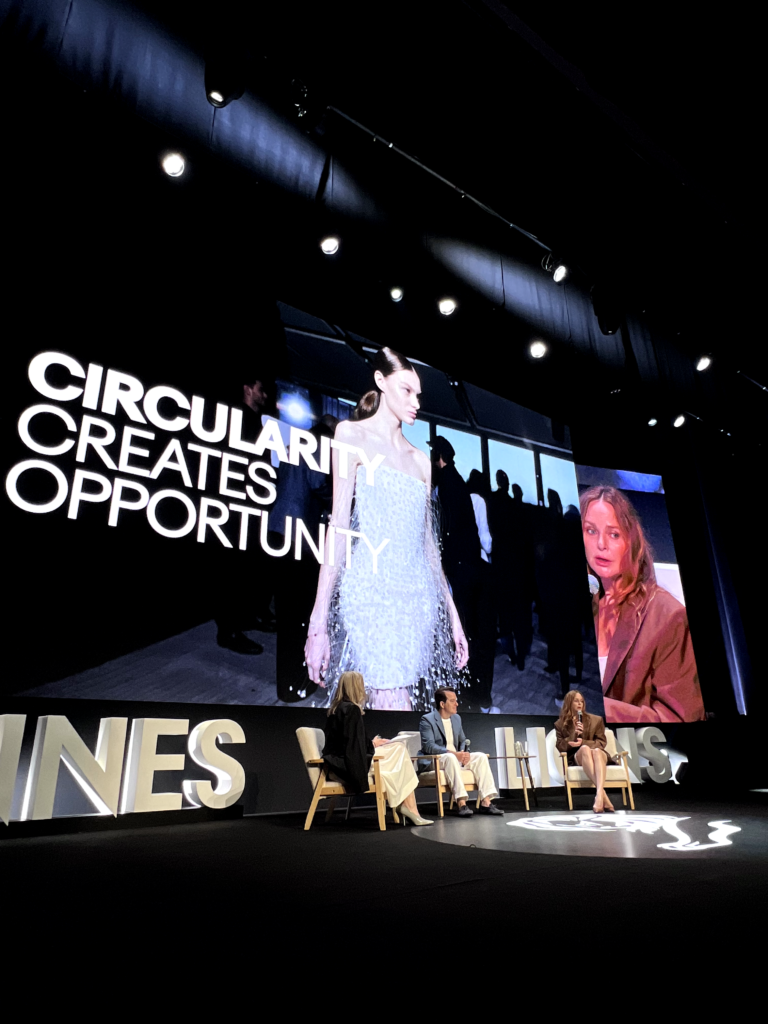
For example, here we are looking at a dress that is fully biodegradable. It has no PVC. It may look like plastic, but of course it is not. And I think that is critical.
For me, circularity is about innovation, supply chain, and then giving a product a second life. If you do that properly, it naturally adds value to the product.
Samantha Conti: Jamie Iannone, Stella has been talking about circularity, innovation and second life. From eBay’s perspective, how are these ideas showing up in major cultural moments? eBay has a front-row seat to how people are wearing pre-loved and resale pieces across different industries. Can you give us a few examples?
Jamie Iannone: I think people would be surprised — I am still surprised — by how often I go somewhere and someone says, “Oh, I bought this on eBay,” or “I bought this vintage piece to complete the look.”
With two and a half billion listings, almost everything is on the platform. And when we talk about e-commerce and sustainability, someone said something to me this week that really stayed with me: everything we could ever want already exists — we just have to find it. I thought that was a very powerful way of putting it.
You see this across culture. Taylor Swift wore a vintage Kansas City Chiefs jacket made from upcycled materials. During the baseball playoffs, I read a story about Ernie Clement, an infielder for the Toronto Blue Jays. His glove was no longer working for him, but he wanted to keep using the same model. So he bought a pre-owned glove on eBay and wore it in the game — because someone else had already broken it in.
We also create many cultural activations around this. At the Met Gala this year, Emily Adams Bode Aujla created looks using pieces and materials sourced from eBay. SZA, for example, came dressed entirely in eBay. That was a very strong statement about the role of recommerce and pre-loved fashion today.
In the UK, one of the biggest fashion stages is Love Island, and we work with them to drive recommerce. In Germany, we are doing the same with Germany’s Next Topmodel.
So across the zeitgeist and across major cultural moments, you increasingly see eBay and pre-loved fashion becoming part of how people express themselves.
Stella McCartney: At the beginning of every season, when we start looking at fabrics, our fabric specialist looks more and more depressed because I’m like, “I don’t want to see new fabrics. I just want to look at deadstock.” Our last collection was around 98% sustainable because we’re working so much with waste. And I love it.
I love that it makes things more collectible, more valuable, more emotional. I love the challenge of working in that way. I think it’s much more difficult to look at a fabric and think, “Okay, I don’t really like that fabric, but there are thousands of metres of it sitting in a warehouse. How can I put that into production? How can I change it? How can I take it apart and re-embroider it? How can I work with it?”
It makes me feel more creative and much more fulfilled as a fashion designer. And I think it’s my responsibility. I think it’s our responsibility. I know that many people in this room are probably quite high up in their professions or want to make positive changes for the environment. I think it’s part of my job to work with waste and to repurpose it.
I wish everyone worked in that way. Obviously, I’d love more people to join me in the way that I work because it would make a really significant positive change for the environment. We have a huge responsibility in fashion. It’s an intensive industry and one of the most harmful, as I said. Every single second, a truckload of fast fashion is buried or burned, and hundreds of millions of trees are cut down for materials. It’s time to make changes. So, yeah, we’re trying.
P.S.Later in the conversation, as the discussion turned to eBay, collecting and the unexpected value objects can acquire on the secondary market, McCartney recalled a story from her childhood:
Stella McCartney: I remember when I was young, Christie’s, or some other auction house, was selling a piece of John Lennon’s toast that a maid had taken from his hotel in the ’60s. It went for something like £100,000.
I remember coming down to breakfast with my dad that morning, and we were eating breakfast, and we were like, “Dad, I think you’ve finished — you’ve finished that toast?” And we started clasping at his food. It’s kind of an eBay story.
Reporting and photos: Julia Brosko.
Translation and editing: Yanina Provotar.